In my Literacy in a Middle/High School class we have been studying the use of vocabulary in our content areas. More specifically, we have been looking at ways in which we can go about teaching our future students the vocabulary. We did this through many readings and class/group discussions, and then we were asked to go a bit further. Our professor asked us to take what we had learned and create our own mini-lesson on vocabulary terms related to our content area. We were allowed to teach however many words we pleased, as long as we created a lesson that would reflect our learning and had the ability to facilitate our students' learning. Once we did this, we actually taught the lesson to a couple of our fellow classmates and recorded our lesson.
Attached is the link to my lesson plan and a video of my lesson.
https://docs.google.com/document/d/1SEaeAIxsJYRea_spo1Fg3TrWwHwi2ZT3oMaMvdVYaZo/edit
I feel that overall this process taught me quite a bit about myself as a teacher. Watching the video back, I was able to realize that I have gained so much confidence standing at the front of the classroom when compared to when I first started in the education program. In fact, I watched one of my old teaching videos from a year ago and compared it to this one, and I seemed like a different person. I could see tremendous improvement in my body language, confidence, comfort, tone of voice, and just overall presence. To see these improvements was incredible. At the beginning of my lesson I asked my "students" to take note on if I used the words "like" and "you guys" too much. When watching the video over I was impressed with myself in the sense that I didn't catch myself using "like" at all. On the other hand, I found myself cringing at how often I used "you guys". Despite this, my classmates all said that they didn't notice me using "like" or "you guys" at all, and one noted that even if I did it wasn't often enough or in a way that it distracted them from their learning.
I learned that teaching students the vocabulary in Mathematics is essential to my students' learning. If they don't understand the terminology that I am using or the book is using, then they may not be able to gain a full understanding of the concepts. Through the readings, discussions, and even my lesson, I was able to see the importance of going deeper than the definition when introducing students to new vocabulary. Instead of simply giving my students a term and the definition that goes along with it, I had them pull from their background knowledge as well as their own experiences to come up with their own definitions, pictures, stories, examples, etc. By allowing for students to have a more prominent role in this process, it allows for them to take ownership in their learning. Not only that, but it helps them gain a deeper understanding of the material when they have to create their own thoughts about the subject, instead of it just being handed to them. Because of this, I think my lesson most closely related to Performance Criteria 7.2: Candidates plan instruction by drawing upon knowledge of learners to meet rigorous learning goals.
Through my students' responses to the exit card, I was able to see that they gained a good base-line understanding of the vocabulary terms. This base-line knowledge was my goal for my students, as I was just introducing students to the vocabulary. In a follow up lesson I would give my students the textbook definitions, as these are very important to have in Mathematics. Once given these definitions we could, as a class, explore through discussions, pictures, games, etc. how the definitions relate to what the students had come up with themselves. It is my hope that the combination of their work along with the actual definitions would help my students gain a greater and deeper understanding of the vocabulary.
When teaching vocabulary lessons in the future I want to take with me everything that I have learned from this lesson. In the future, I would also like to do a better job of preparing myself for possible questions students may have during my lesson. By doing this, it is my hope that I would be able to give my students better explanations, which in turn would help them gain a better understanding. Overall, I thought this lesson was successful, as I could see growth in my students' learning from the beginning to the end of the lesson was seen through their Exit Card responses.
Monday, October 30, 2017

Sunday, October 15, 2017
1:1 Techonology Initiative
Last week, in my Education courses for the semester,
we worked in our content groups to create
a hypothetical 1:1 technology initiative in our mock school. In
the first class we worked together in our groups to write up a letter about our
technology initiative. The purpose behind this letter was to be able to send it
to families to inform them of the initiative, possible concerns they may have,
and how it is beneficial. In our second class, we researched a plethora
of student usage contracts that have been implemented in other schools in the
area, and then we used our research as a reference to create our own. Here are
the links to both the letter and the contract:
Mock Digital Literacy Letter
Technology Contract
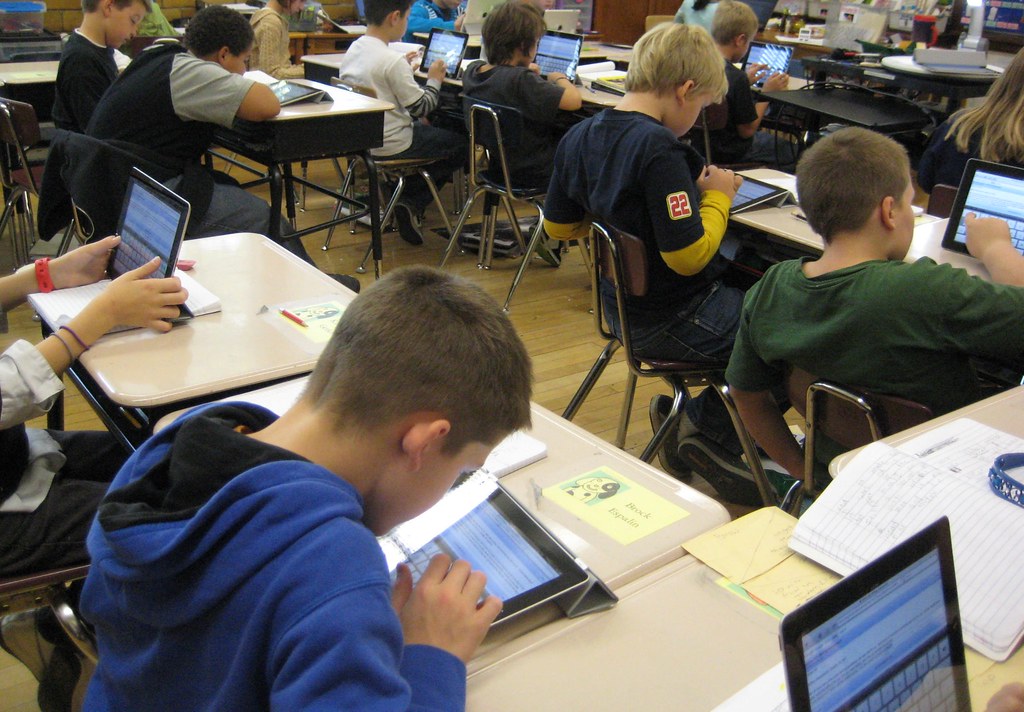 By implementing technology into the classroom, we want
students to be well prepared to handle technology in the real world by the
time they graduate. In order to this, we hope to increase their skills in
digital citizenship. We also hope they learn to be responsible with technology
and use it in ways that are beneficial to learning. Our goal is that our
students will see the opportunity in this integration and embrace the
challenges that may come with it, as can be seen in both out letter and
contract.
By implementing technology into the classroom, we want
students to be well prepared to handle technology in the real world by the
time they graduate. In order to this, we hope to increase their skills in
digital citizenship. We also hope they learn to be responsible with technology
and use it in ways that are beneficial to learning. Our goal is that our
students will see the opportunity in this integration and embrace the
challenges that may come with it, as can be seen in both out letter and
contract.
I am both nervous and excited about the use of technology in the classroom. With technology, there is the possibility that problems could arise. Some students may not have access to everything, it could easily become a distraction, it can be expensive, there can be technological issues, and I have to make sure I am knowledgeable with the technology in order to teach my students about it. However, these are all things that I will need to prepare for, as they are a reality. I can prepare for these problems by making sure to always have back up plans in case something doesn’t work as I thought it would for one reason or another.
With this being said, I do see the integration of technology in the classroom as an incredible opportunity for both the teacher and students if grasped and used properly. Technology can help in assisting students with a variety of different learning differences, increase opportunity for global communication, give students multiple options and ways of both seeing and doing assignments, prepare students for their future, and so much more. Because of this, it is my goal to integrate technology in my classroom wherever possible. I hope to mold my students into confident users in all areas of technology. With all of this being said, I think it is important to still use the traditional methods in the classroom as well, as it can spark students’ interests in different ways, and every student learns in their own ways. By creating this balance, I hope my students will be prepared for whatever their futures may hold.
Mock Digital Literacy Letter
Technology Contract
I am both nervous and excited about the use of technology in the classroom. With technology, there is the possibility that problems could arise. Some students may not have access to everything, it could easily become a distraction, it can be expensive, there can be technological issues, and I have to make sure I am knowledgeable with the technology in order to teach my students about it. However, these are all things that I will need to prepare for, as they are a reality. I can prepare for these problems by making sure to always have back up plans in case something doesn’t work as I thought it would for one reason or another.
With this being said, I do see the integration of technology in the classroom as an incredible opportunity for both the teacher and students if grasped and used properly. Technology can help in assisting students with a variety of different learning differences, increase opportunity for global communication, give students multiple options and ways of both seeing and doing assignments, prepare students for their future, and so much more. Because of this, it is my goal to integrate technology in my classroom wherever possible. I hope to mold my students into confident users in all areas of technology. With all of this being said, I think it is important to still use the traditional methods in the classroom as well, as it can spark students’ interests in different ways, and every student learns in their own ways. By creating this balance, I hope my students will be prepared for whatever their futures may hold.
Subscribe to:
Posts (Atom)